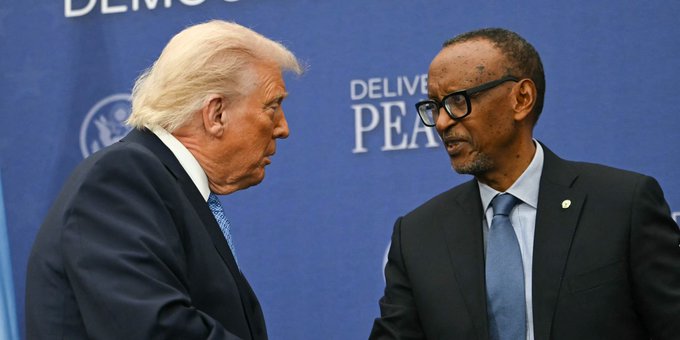

The U.S. Department of the Treasury announced on March 2, 2026, that its Office of Foreign Assets Control (OFAC) has imposed sanctions on the Rwanda Defence Force (RDF) and four of its senior officials. This action directly condemns what the U.S. describes as blatant violations of the Washington Accords for Peace and Prosperity, a peace agreement signed in Washington, D.C., on December 4, 2025, under U.S. President Donald Trump’s mediation between the Democratic Republic of the Congo (DRC) President Félix Tshisekedi and Rwandan President Paul Kagame.
Key Reasons for the Sanctions
The Treasury accuses the RDF of actively supporting, training, and fighting alongside the March 23 Movement (M23), a rebel group designated and sanctioned by both the U.S. and the United Nations. M23 has been linked to severe human rights abuses, including summary executions, violence against civilians, and contributing to a mass displacement crisis in eastern DRC.
– M23’s recent territorial gains, including control over areas like provincial capitals Goma and Bukavu, as well as strategic mining sites, were deemed impossible without RDF’s direct involvement and complicity.
– Violations escalated shortly after the accords’ signing, with M23 capturing the city of Uvira (near the DRC-Burundi border) in clear breach of the agreement, leading to civilian deaths and further displacement.
– The U.S. emphasized that continued RDF backing risks escalating the conflict into a broader regional war.
The sanctions are imposed under Executive Order 13413 (as amended), targeting actions that threaten the peace, security, or stability of the DRC, and for providing material support to M23.
Sanctioned Entities and Individuals
– Rwanda Defence Force (RDF) as an entity.
– Four senior officials:
1. Vincent Nyakarundi, the Army Chief of Staff
2. Ruki Karusisi, a Major General and Commander of the 5th Infantry Division
3. Mubarakh Muganga, the Chief of Defence Staff
4. Stanislas Gashugi, a Special Operations Force Commander
Implications of the Sanctions
All property and interests in property of the RDF and the named individuals that are in the U.S. or under U.S. persons’ control are blocked and must be reported to OFAC. U.S. persons are generally prohibited from engaging in transactions with them unless authorized by a license. The Treasury also issued an associated General License (GL 1) to allow for the wind-down of certain transactions involving the RDF.
Treasury Secretary Scott Bessent stated: “President Trump is the Peace President, and Treasury will use all tools at its disposal to ensure that the parties to the Washington Accords uphold their obligations.” The U.S. State Department echoed this, calling for the immediate withdrawal of RDF troops, weapons, and equipment from eastern DRC, while highlighting the need to uphold the accords for regional peace and prosperity (including access to critical minerals).
This move reflects the Trump administration’s push for accountability in the region, during ongoing fighting despite the 2025 peace deal. Rwanda has reportedly rejected the sanctions as “unjust” and “one-sided.” The situation in eastern DRC remains volatile, with potential for further diplomatic measures depending on compliance.