

Uganda, Ethiopia, South Sudan, and Djibouti signed an agreement to establish the Djibouti-Ethiopia-South Sudan-Uganda (DESSU) Corridor Authority, a landmark initiative designed to strengthen regional trade, improve infrastructure, and enhance economic integration across East Africa.
The ceremony was held at the Djibouti Palace Kempinski, in the presence of the Ministers of Transport of Djibouti, Ethiopia, South Sudan and Uganda, as well as the Ambassador of the European Union.
This major step comes a year after the signing of a memorandum of understanding on this strategic corridor, also known as DESSU. The new authority will be responsible for coordinating implementation, regulatory harmonization, and infrastructure development along the corridor.
The new corridor is expected to streamline trade operations, reducing transportation costs and transit delays while improving access to global markets. By linking Ethiopia, South Sudan, and Uganda to Djibouti’s strategic port, the initiative aims to enhance supply chain efficiency and boost exports from landlocked countries.
For Djibouti, a key port platform on the Red Sea, the stakes are as much economic as political. “The DESSU Corridor is a powerful illustration of the principles of the African Union and its Agenda 2063. It embodies ‘the Africa we want’: an integrated continent where borders are no longer barriers, but bridges,” declared Djibouti’s Minister of Infrastructure and Equipment, Hassan Houmed Ibrahim.
Aligned with the objectives of the African Continental Free Trade Area (AfCFTA), the corridor will also consolidate the regional anchoring of the four countries within the Intergovernmental Authority on Development (IGAD) and the Common Market for Eastern and Southern Africa (COMESA).
Minister Edward Katumba Wamala stressed urgency in the implementation phase: “The real work begins now.” He called for turning the DESSU agreement into tangible wins, upgraded roads/railways, new air links, and swift removal of non-tariff barriers. With infrastructure as a core pillar, border upgrades and digital trade tools will ensure seamless goods flow from Djibouti to Uganda’s Great Lakes hubs.
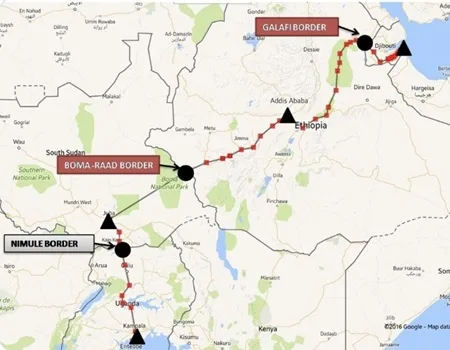
Ethiopia acknowleges the project as a vital lever to support its growth.
“The DESSU Corridor is not simply a transport route. It is a strategic axis for regional integration and shared prosperity,” stated its Minister of Transport and Logistics, Alemu Sime Fayisa. Addis Ababa intends to play a key role in connecting the Great Lakes countries with Djibouti’s ports.
For South Sudan, one of the continent’s landlocked countries, the agreement has strategic significance. Its Minister of Transport, Rizik Zakaria Hassan, described the day as “historic,” promising to expedite national ratification of the text.
According to Djiboutian authorities, the corridor will link the port of Djibouti to Addis Ababa, Jimma, Boma, Raad, Kapoeta, Nimule, Gulu and Kampala, forming a continuous supply chain from global maritime routes to inland production and consumption centers.
The expected benefits are significant: lower logistics costs, reduced transit times, and improved supply chain reliability. In the long term, the partner governments anticipate increased trade volumes, enhanced industrial development, and sustained growth across the region.