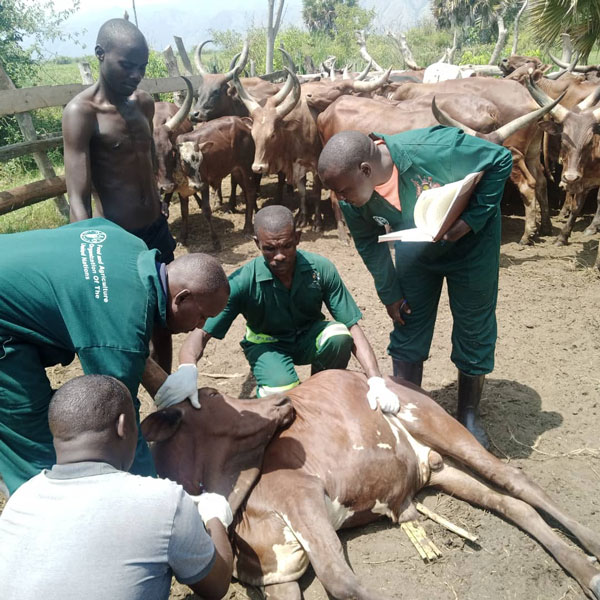

Uganda is preparing to roll out its first-ever nationwide mass vaccination campaign against Foot and Mouth Disease (FMD), with the exercise scheduled to begin in July and conclude in August 2026.
The landmark campaign comes after the completion of ongoing farmer registration, onboarding, and vaccine distribution activities being carried out across various districts under the National FMD Cost Recovery Scheme, which was introduced earlier this year.
Government and Farmers Share Responsibility
Under the new vaccination framework, the government will provide vaccines and meet all associated operational costs, including logistics, cold chain storage, vaccine distribution, disease surveillance, and veterinary supervision. Farmers will contribute a subsidized fee for each vaccine dose administered during the mandatory biannual vaccination campaigns.
The guidelines require farmers to pay:
* Shs8,000 per dose for cattle and pigs
* Shs4,000 per dose for goats and sheep
The mass vaccination programme will be conducted twice every year as part of efforts to safeguard Uganda’s livestock population and reopen access to international livestock markets.
In addition, all livestock farmers are required to register in the national FMD vaccination database. Authorities have warned that farmers who fail to comply may face restrictions when accessing lucrative dairy and livestock markets.
Preparations in High Gear
Speaking at the Uganda Media Centre on June 14, the Minister of State for Animal Industry, Col. (Rtd) Bright Rwamirama, said veterinary teams throughout the country are finalizing detailed vaccination plans and organizing the logistical support required for the nationwide exercise.
According to the minister, the campaign will target an estimated 45.5 million susceptible animals across Uganda, including:
* Approximately 16.5 million cattle
* 17.4 million goats
* 4.5 million sheep
* Nearly 8 million pigs
He noted that the government’s long-term goal is to achieve and sustain vaccination coverage of at least 80 percent of all susceptible animals during every vaccination cycle.
Rwamirama emphasized that controlling FMD requires collective action, urging all stakeholders to actively participate in the campaign.
“The fight against Foot and Mouth Disease cannot be won by government alone. It requires a concerted effort from all stakeholders,” he said.
Registration Progress
As of June 2026, about 20,000 farmers had successfully been enrolled in the national FMD vaccination system, while approximately 3.5 million susceptible animals had already been registered for vaccination.
The registration exercise has been conducted in major livestock-producing districts, including Nakaseke, Lyantonde, Kiruhura, Rukungiri, Kasese, Kazo, Isingiro, Rakai, Kayunga, Mbarara, Ibanda, Kyegegwa, Mubende, Kasanda, Gomba, Kyankwazi, Kiboga, Mpigi, and Ntungamo. Authorities say additional districts will soon be brought on board.
Understanding Foot and Mouth Disease
Foot and Mouth Disease is a highly contagious viral infection that affects cloven-hoofed animals such as cattle, goats, sheep, pigs, and certain wild animals.
Globally, it is considered one of the most economically destructive livestock diseases and remains the leading disease-related obstacle to trade in animals and animal products at local, regional, and international levels.
The virus spreads rapidly through direct contact with infected animals and contaminated equipment, feeds, vehicles, animal products, and people moving between farms. Transmission can also occur through tiny droplets released by infected animals.
Although FMD rarely causes high death rates among adult animals, its economic impact is severe. Outbreaks often lead to reduced milk and meat production, diminished breeding potential, market closures, movement restrictions, and lost trade opportunities, resulting in substantial losses for farmers and the wider economy.
Livestock Sector Driving Economic Growth
Uganda’s livestock industry continues to play a vital role in boosting foreign exchange earnings and supporting national economic growth.
In 2024, the country earned more than Shs1 trillion, equivalent to approximately $285 million, from dairy exports. In 2026, earnings have increased to over Shs1.4 trillion, or about $385 million, driven by rising milk production, value addition initiatives, and expanded access to regional and international markets.
Milk production currently stands at 5.3 billion litres, reflecting the sector’s growing importance to the economy.
Uganda also generated approximately Shs48 billion, or $12.9 million, from exports of hides and skins, while gelatin and related products earned the country about Shs24 billion, equivalent to $6.5 million.
With the nationwide vaccination campaign set to begin, the government hopes to strengthen livestock health, improve productivity, protect farmers’ incomes, and further enhance Uganda’s position in regional and global livestock trade.