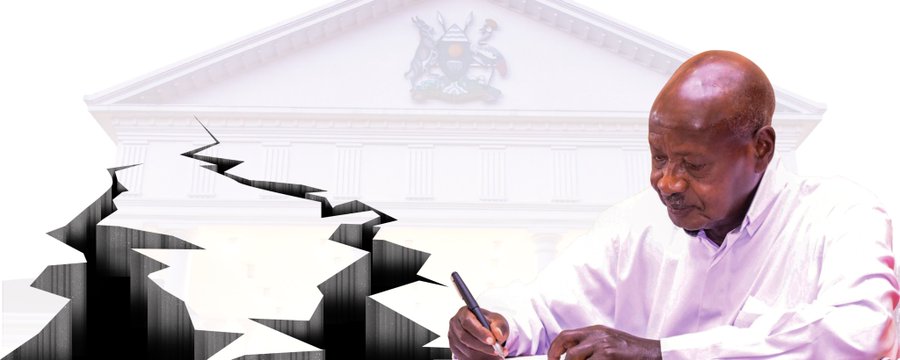

President Yoweri Museveni has issued an Executive Order directing government agencies to strengthen Uganda’s preparedness for earthquakes through stricter building standards, nationwide inspections, and improved enforcement of construction regulations.
The President said Uganda’s location along three major fault lines River Aswa, River Katonga, and the Rift Valley makes the country vulnerable to earthquakes, citing lessons from the 1966 Tooro earthquake, the 1994 Kisomoro earthquake, and the 2016 Katonga earthquake.
Museveni noted that while several buildings were damaged during previous tremors, Virika Cathedral in Fort Portal remained intact because it had been deliberately designed to withstand earthquakes, demonstrating the importance of resilient construction. He also pointed to Japan’s experience in reducing earthquake-related deaths through improved engineering and building standards.
Under the directive, engineers from the Ministries of Works, Lands, Local Government, KCCA and local governments have been ordered to inspect and document the structural integrity of all permanent buildings within two years, beginning with high-rise structures.
The President also instructed engineers, working with public universities and international experts, to develop national earthquake-resistant building standards within 12 months. Once adopted, all new permanent buildings must comply with the revised standards, while experts will recommend how to reinforce existing structures that fail to meet the requirements.
Museveni further encouraged engineers to draw lessons from traditional Ugandan architecture, whose lightweight designs were naturally more resistant to collapse during earthquakes, while modernising them with safer building materials.
He said the measures are intended to prevent catastrophic loss of life and property, ensuring Uganda avoids disasters like the devastating earthquakes that struck Turkey and Syria, where tens of thousands of people were killed and millions displaced. EXECUTIVE ORDER NO. 3 2023