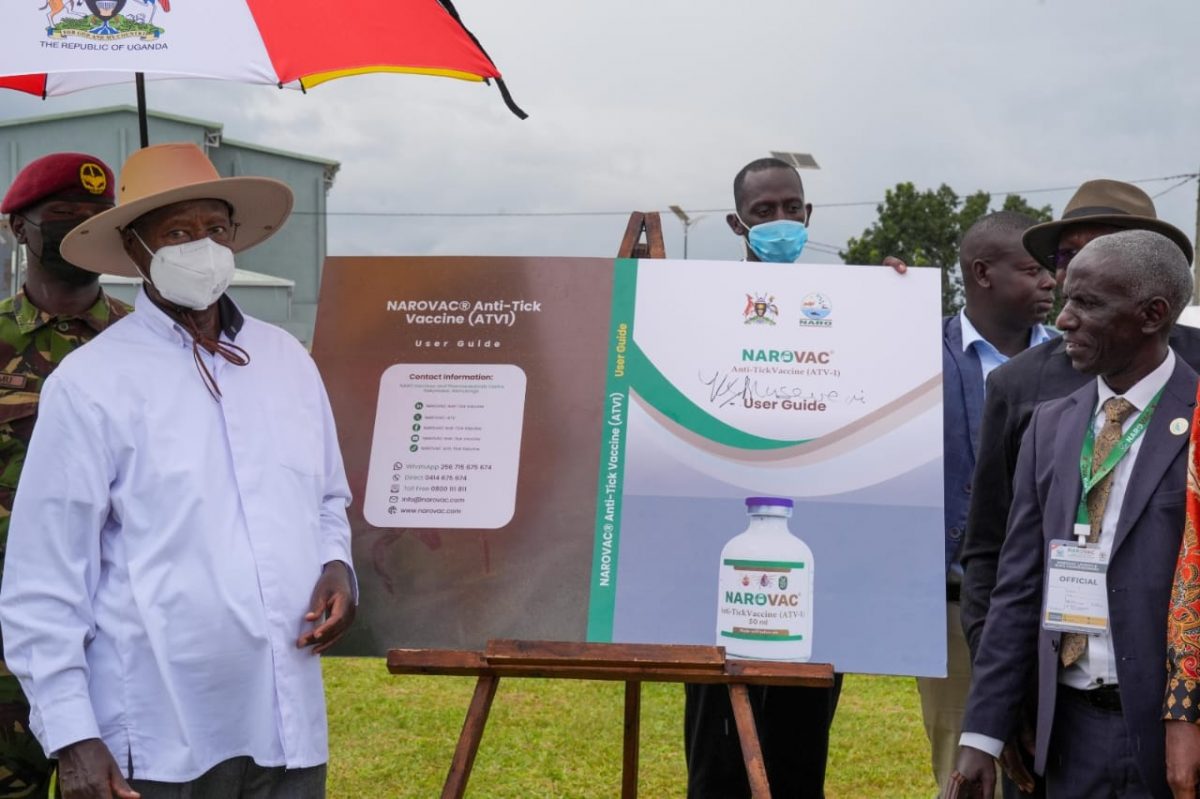

Uganda has taken a major step in agricultural innovation following the launch of the country’s first locally developed anti-tick vaccine, a breakthrough expected to transform livestock farming and strengthen food security across the region.
The milestone was marked on April 30, 2026, when President Yoweri Kaguta Museveni officially unveiled the vaccine, branded NAROVAC®-ATV1, and commissioned a modern vaccine production facility at the National Agricultural Research Organisation (NARO) – National Livestock Resources Research Institute (NaLIRRI) in Nakyesasa, Wakiso District.
For years, ticks and tick-borne diseases have severely affected livestock farmers across Africa, causing major economic losses through reduced milk production, poor animal growth, and high cattle deaths. The introduction of NAROVAC®-ATV1 is now being celebrated as a scientific breakthrough that could significantly reduce those losses and improve livestock productivity.
Developed by Ugandan scientists using recombinant technology, the vaccine is designed from antigens derived from local tick species. According to Dr. Swidiq Mugerwa, NARO’s Deputy Director General for Research, the vaccine works by stimulating cattle to produce antibodies that attack ticks when they feed on the animal’s blood.The vaccination schedule involves three initial doses administered over six months, offering protection for up to one year, followed by booster doses every six months to maintain immunity.
The innovation also represents a major shift from the heavy use of acaricides chemical tick-control substances that have become less effective due to increasing tick resistance and growing concerns over environmental and food safety.
President Museveni described the development as part of Uganda’s broader transition toward a science-driven economy, highlighting the growing role of research and innovation in national development.
NARO Director General Dr. Yona Baguma revealed that the vaccine is the first of its kind in Africa and only the second globally. Research on the project began in 2013, with scientists collecting ticks from ten agro-ecological zones across Uganda to develop and test several vaccine candidates.
Extensive laboratory studies and field trials conducted in regions including Mbarara, Maruzi, Nabuin, and Uganda Prisons farms showed the vaccine to be 93.2 percent effective against major tick species such as the Brown ear tick, Blue tick, and Bont-legged tick among the most destructive cattle parasites in the country.
The Government of Uganda invested approximately UGX 170 billion into the research, testing, infrastructure, and staffing required for the project. The newly commissioned production facility is expected to manufacture up to 36 million doses annually, positioning Uganda as a continental leader in livestock health innovation and agricultural biotechnology.