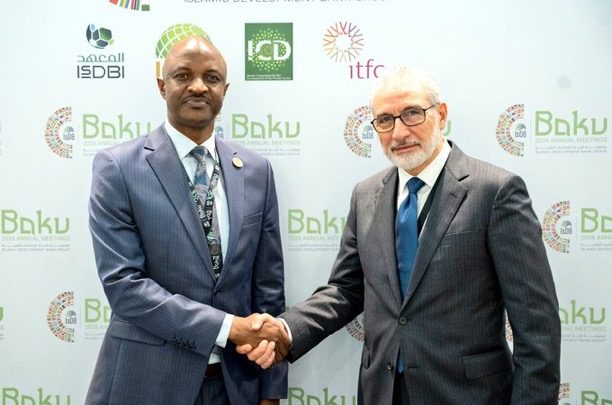

Uganda has achieved a major breakthrough in its infrastructure development agenda after securing a record Shs2.73 trillion (€650.75 million) financing package from the Islamic Development Bank (IsDB) for the construction of critical sections of the Standard Gauge Railway (SGR).
The approval, granted during the 51st IsDB Group Annual Meetings held in Baku, Azerbaijan, from June 16 to 19 under the theme *“Regional Integration for Sustainable Prosperity,”* represents the largest amount ever approved by the Bank’s Executive Board for a single project in Uganda.
The landmark financing marks a significant milestone for the long-awaited railway project, which is expected to revolutionize cargo transportation, lower logistics costs, and enhance regional trade connectivity between Uganda, Kenya, and the wider East African region.
Uganda’s delegation to the annual meetings was led by Ramathan Ggoobi, Uganda’s Temporary Governor to the IsDB. During the engagements, Ggoobi reaffirmed the government’s commitment to achieving financial closure for the railway project by November 2026.
Funding Critical Railway Infrastructure
The IsDB financing will support some of the most complex and costly components of the railway. These include the construction of the 553-metre Jinja Nile Bridge, the 2.12-kilometre Mbuya-Kampala tunnel, six railway stations located in Tororo, Iganga, Jinja, Lugazi, Kampala East, and Kampala City, as well as three maintenance workshops in Kampala East, Jinja, and Tororo.
The funding comes as Uganda continues mobilizing resources for the 272-kilometre Malaba-Kampala Standard Gauge Railway, a project estimated to cost approximately Shs11.34 trillion (€2.7 billion).
With the newly approved Shs2.73 trillion covering nearly a quarter of the total financing requirement, the government still needs to secure about Shs8.61 trillion to achieve full financial closure.
A Strategic Regional Transport Link
The Malaba-Kampala railway line is the backbone of Uganda’s planned SGR network. Once completed, it will connect seamlessly with Kenya’s Standard Gauge Railway, creating a faster and more cost-effective corridor for cargo movement between the Port of Mombasa and inland markets across Uganda and neighboring countries.
The financing approval follows the official launch of construction works by President Yoweri Museveni, who recently handed over the project to Turkish engineering firm Yapi Merkezi.
Yapi Merkezi, which secured the engineering, procurement, and construction contract, is tasked with building Uganda’s first modern standard gauge railway line. The company has extensive experience in railway development across Africa, including major sections of Tanzania’s Standard Gauge Railway.
Government officials maintain that the project is critical to reducing the cost of doing business, improving trade efficiency, and strengthening Uganda’s competitiveness as regional economies continue investing heavily in modern transport infrastructure.
Strengthening Uganda–IsDB Partnership
The latest approval further highlights the growing partnership between Uganda and the Islamic Development Bank.
As of May 2026, Uganda and the Bank had signed eight public-sector operations comprising loans and grants worth $896.55 million. Transport infrastructure accounts for the largest share of this portfolio, valued at approximately $721 million.
Among the projects financed by the IsDB are the Technical and Vocational Education and Training (TVET) programme, the upgrading of the Muyembe-Nakapiripirit Road, the Rwenkunye-Apac-Lira-Acholibur Road Project, and irrigation schemes in Unyama, Namalu, and Sippi.
Additional Bank-supported initiatives include the upgrading of the Katine-Ochero Road and associated town roads in Kaberamaido and Kalaki, construction of the Masindi Port Bridge, road improvements in Kyenjojo District, the Kumi-Ngora-Serere-Kagwara Road Project, and the establishment of regional oncology centres in Arua and Mbale.
Call for Stronger Development Financing
During the Governors’ Roundtable, Ggoobi welcomed the launch of the IsDB Concessional Fund (ICF), a financing mechanism introduced in 2026 to increase concessional financing to approximately 15 percent of the Bank’s annual approvals.
He noted that the initiative arrives at a crucial time when many developing countries are facing declining and increasingly unpredictable foreign aid flows.
“The Fund is crucial in light of the declining traditional foreign aid flows, both in volume and reliability, widening the financing gap,” Ggoobi said.
He also urged multilateral development finance institutions to undertake reforms that would make them more inclusive, adaptive, and responsive to the evolving needs of member countries.
“Given the changes in the global financial architecture, there is need for multilateral development finance institutions such as IsDB to reform and become more inclusive, adaptive and responsive to the needs of their member countries,” he said.
Fresh Momentum for Uganda’s Ambitious Railway Vision
The record-breaking approval is expected to inject fresh momentum into one of Uganda’s most ambitious infrastructure projects. It also strengthens confidence in the government’s efforts to mobilize the remaining financing required to deliver the Standard Gauge Railway—a transformative project that has faced years of delays but remains central to Uganda’s long-term economic and regional integration ambitions.